


More than a year after Generative AI (Gen AI) swept the globe, the financial services industry is entering a new turning point. Many decision-makers are beginning to ask more direct questions: “We have seen many demonstrations of AI applications, but where is the real business value?” According to the latest research from Google Cloud, AI adoption in the financial industry is moving from the experimental stage to substantive applications centered around Agentic AI. The report points out that among financial institutions that have deployed AI in production environments, as high as 77% have seen clear ROI. This not only represents an improvement in technical capabilities but also indicates that the operational models of the financial industry are beginning to undergo deep transformations.1
The Explosion of Intent-Based Computing: Why AI Agents Are the Watershed Moment for the Financial Industry in 2026?
- Pain Point: Traditional AI often acts like an encyclopedia that answers questions but cannot truly execute complex business processes. Employees need to input precise instructions and manually transfer data between multiple systems, leading to bottlenecks in efficiency improvements.
- Solution: The core shift in 2026 is moving from “Instruction-Based Computing” to “Intent-Based Computing.” AI is no longer just a chatbot; it has become an “AI Agent” capable of understanding goals, formulating plans, and executing tasks across systems.
- Evidence: Currently, 53% of financial executives state that their organizations have adopted AI agents, and 40% of enterprises have deployed more than 10 AI agents. This transformation has led 76% of enterprises to report increased productivity, with 36% of employees even achieving a “doubling” of their output capacity.
| Past: instrcution-based | 2026: intent-based |
| Employees had to tell the AI: “Please help me retrieve data from System A, format it, and paste it into Report B.” | Employees only need to state the goal: “Please analyze this customer’s credit risk and prepare a loan approval recommendation.” The AI agent will then autonomously direct market news agents, deep data research agents, and financial modeling agents to work collaboratively. |
Three Golden Scenarios for Widespread Adoption of AI Agents in the Financial Industry
- Pain Point: The financial industry faces extremely strict regulatory requirements, and fraud techniques continue to evolve. Meanwhile, KYC (Know Your Customer) processes are often time-consuming and cumbersome, becoming a significant challenge for many financial institutions when expanding their business.
- Solution: Highly complex processes and massive data volumes make the following areas the application scenarios with the highest adoption rates for AI agents in the financial industry.
- Fraud Management and Detection (AI Adoption Rate: 43%): AI can correlate massive amounts of data in real-time to find hidden criminal patterns.
Case Study: UK challenger bank Starling Bank launched an anti-fraud AI tool. When customers upload advertisement images, the system can identify signs of fraud within seconds. Tests showed that AI could identify 2 to 4 times more suspicious activities than traditional methods. - Risk Management (AI Adoption Rate: 42%): Automatically tracking market fluctuations and asset allocation across systems via AI agents.
Case Study: Germany’s largest bank, Deutsche Bank, also launched the “DB Lumina” digital assistant. It automates complex data analysis and provides real-time insights while fully complying with the financial industry’s strict data privacy regulations. - Customer Onboarding and KYC (AI Adoption Rate: 41%): Automating identity verification, shortening processes that originally took days to just minutes.
Case Study: Global bank HSBC uses AI to automate the handling of massive anti-money laundering alerts. AI agents can autonomously collect external negative news and legal records, allowing compliance officers to focus on high-risk decisions.
Microfusion Technology, as a strategic partner of Google Cloud, specializes in transforming Generative AI into measurable ROI through rigorous PoC (Proof of Concept) validation and system integration. We combine forward-looking technologies such as Gemini, Vertex AI, and BigQuery to build high-precision, high-conversion AI agent systems for enterprises, ensuring that technology applications align with business growth.
Precise Profitability Layout: Three Core Areas with High AI Agent ROI
The question enterprises care about most is often very direct: “What actual revenue can AI bring to the enterprise?” Currently, three areas have been proven to bring significant financial returns to enterprises:
1. Customer Service and Experience (AI ROI: 42%)
Pain Point: Traditional chatbots can only handle simple instructions like “check balance.” When encountering complex issues, they still need to be transferred to human agents, leading to high customer frustration and substantial customer service labor costs for enterprises.
Solution: Upgrade to an “Proactive Exclusive Concierge” (Agentic Concierge). AI agents can “ground”2 themselves in enterprise internal data, possess reasoning capabilities, proactively detect problems, and even complete services before the customer asks.
Case Study: In proactive protection scenarios, an AI agent can detect that a customer’s account is about to be charged a $150 trial fee for an App the customer has never used. The system will proactively send an SMS asking if the subscription needs to be canceled and, upon receiving a reply, automatically complete the unsubscription process across systems. This proactive service model has brought significant results, with 67% of financial institutions stating that AI has significantly improved customer experience.
2. Finance, Accounting, and Security Operations (AI ROI: 35%)
Pain Point: Security Operations Centers (SOCs) face extremely severe alert fatigue, with 82% of analysts worried about missing real threats due to the massive volume of data alerts.
Solution: Implement a “Semi-Autonomous Defense” mode. AI agents take over front-line data management, classification investigations, and malware analysis, upgrading human analysts from passive observers to strategic defenders.
Case Study: US fintech giant Apex Fintech Solutions used the Google Gemini model to drastically reduce the time required to write complex threat detection code from hours to seconds. Overall, after implementing AI, 81% of enterprises reported improved threat identification capabilities, and 66% reported shortened resolution times.
3. Marketing and Business Promotion (AI ROI: 33% – 35%)
Pain Point: In the highly regulated financial environment, marketers struggle to balance “personalized communication” with “regulatory review,” leading to slow launch times for marketing campaigns.
Solution: AI agents can automate regulatory review processes and understand complex regulations, translating professional financial products into easy-to-understand copy suitable for different audiences.
Case Study: Taiwan’s indicator bank, Far Eastern International Bank, previously relied on manual collection of public opinion, facing pain points of low efficiency and strict security compliance. With the assistance of Microfusion Technology, they implemented Google Cloud Vertex AI and BigQuery to create an automated analysis platform. Results showed that the system achieved 100% utilization of external public data, accurately grasping volume without touching personal data, creating a new paradigm for the safe application of Generative AI in the financial industry.
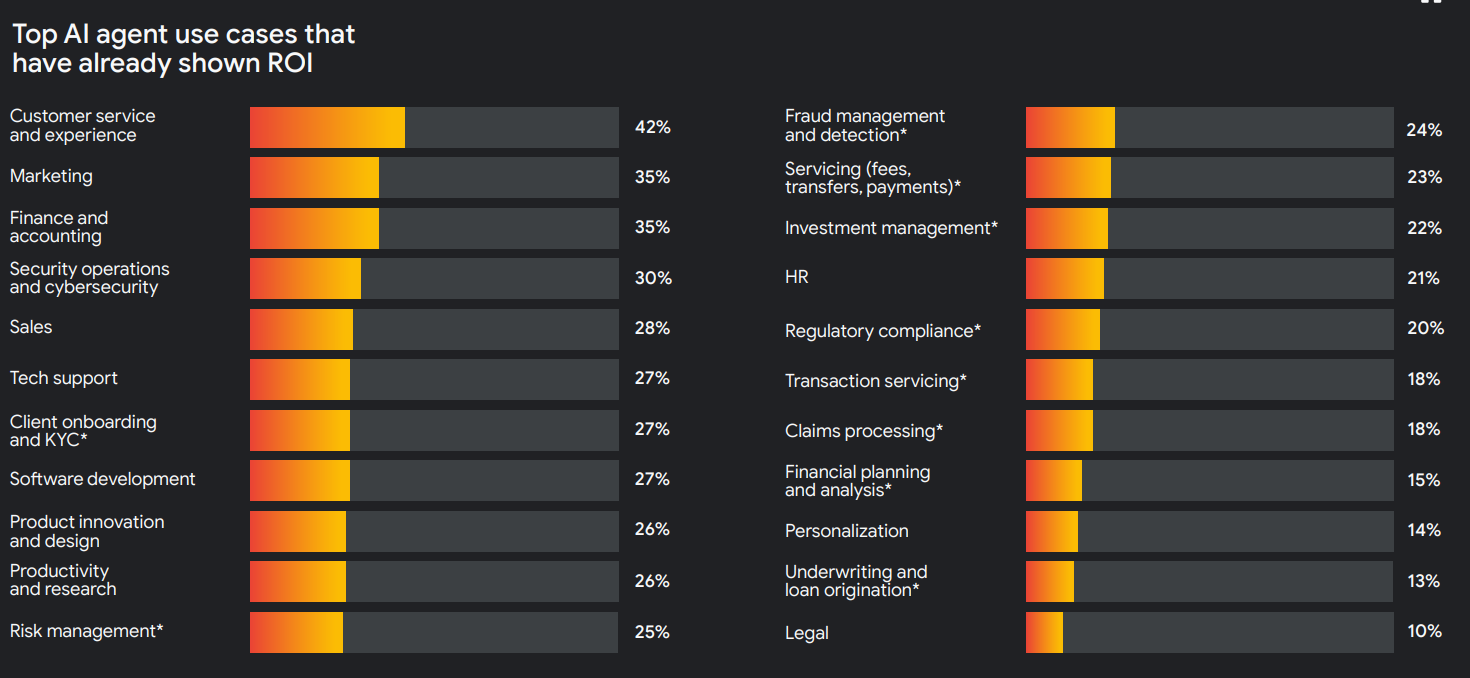
Ranking of AI Agent Scenarios by Actual ROI
Decision-Maker’s Guide: The Cornerstones for Ensuring ROI Implementation
- Pain Point: Many AI projects remain at the POC (Proof of Concept) stage and fail to scale, or are blocked by compliance departments due to security concerns.
- Solution: Successful enterprises do not just buy technology; they establish a complete governance and empowerment system.
- C-Level Strategic Support: Organizations with clear vision from the decision-making level achieve ROI at a rate of 82%, far higher than enterprises lacking support.
- Security and Data Governance: 43% of financial executives view “data privacy and security” as the primary concern. It is essential to establish security frameworks (such as SAIF) and ensure AI agents have controlled system access rights.
- Talent Skill Upgrading: The half-life of technical skills has shortened to 2 years. Enterprises need to establish learning paths so that employees learn how to become “Supervisors of AI Agents.”
Meeting the Challenges of Financial Transformation in 2026
AI in the financial industry is no longer a future imagination; it is happening now. The gap between enterprises will widen rapidly in 2026, and the winners will be those who can build digital pipelines, deeply integrate AI agents into business processes, and liberate teams from repetitive, low-value work. Meanwhile, the half-life of technical skills has shortened to just two years. For enterprises to succeed, the key is not just introducing new technologies but redefining talent roles: transforming employees into commanders who manage and collaborate with AI. When humans can focus on creativity, strategy, and empathy—areas that AI finds difficult to replace—organizations can truly become faster, smarter, and more competitive.
Want to know how your business can take the first step toward AI-driven transformation?
Contact our team of consultants today to assess your ROI potential and develop a customized roadmap for your AI-driven transformation.
1 AI Agent Trends 2026 in Financial Services, Google Cloud
2 Grounding: This refers to connecting the AI model with real-time, authentic internal enterprise data. This ensures that the AI’s responses are accurate and evidence-based, rather than being fabricated information (hallucinations) generated out of thin air.
3 Other sources:ROI of GenAI in Financial Services, Google Cloud
4 Other sources:ROI of AI in Financial Services, Google Cloud