

After adopting AI, why haven’t most enterprises seen the expected productivity explosion? The key reason often stems from an overlooked hidden cost—the “Fragmentation Tax”1. On average, a company needs to interact with as many as 254 independent AI applications. Employees frequently switch between different systems throughout the day, and each switch incurs an average context-switching cost of approximately 23 minutes. When information is scattered across isolated system silos like email, CRM, and cloud drives, it not only fails to improve efficiency but actually makes decision-making processes more cumbersome and ineffective.
The real problem isn’t that AI isn’t powerful enough—it’s that enterprises are still thinking in terms of adopting single-point tools. To break through this bottleneck, the key lies in shifting from fragmented tools to Agentic AI that can connect tasks and execute across systems, enabling AI to become not just an assistant, but a true digital workforce capable of participating in and completing work.
Mindset Revolution: From Single-Point Tools to End-to-End Agents
In the second half of digital transformation, enterprises are facing a mindset revolution—shifting from single-point tools to an agentic ecosystem. In the past, scattered AI tools solved specific tasks but, due to their isolation, created switching costs. Employees had to manually transfer information between different systems, even increasing security risks. The real breakthrough lies in adopting Agentic Workflows: these AI Agents are no longer passive chatbots waiting for commands, but digital partners capable of deeply understanding enterprise knowledge, possessing reasoning abilities, and executing complex tasks across systems. By 2028, it is projected that one-third of enterprise software will have such AI built-in, capable of autonomously completing 15% of routine decisions2 . Only by transforming office environments from simple automation to agentic environments with AI actionability can enterprises completely eliminate friction between systems, freeing employees from cumbersome processes and allowing them to focus their energy on the most creative and valuable business decisions.
Through Google’s enterprise-grade AI agent platform, Gemini Enterprise, AI is no longer just a chatbot that passively answers questions—it evolves into an “AI Agent” with memory, reasoning, and planning capabilities. These agents can search for information across systems, understand deep enterprise expertise, and even handle unexpected situations and remove obstacles, truly representing employees in autonomously executing complex end-to-end workflows. This means enterprises will move beyond the limitations of “one tool solving one problem” and officially enter a new era of fully automated workflows.
Proven Case Studies
- Healthcare: Seattle Children’s Hospital used AI agents to reduce the time required to access clinical standard operating procedures from 15 minutes to just a few seconds.
- Financial Services: Brazil’s largest private financial institution, Banco BV, uses Gemini Enterprise for faster and more comprehensive analysis, transforming team collaboration through new multimodal ways of interacting with content.
Building Enterprise-Grade Trust: Eliminating Shadow IT and Security Concerns
As enterprises actively adopt AI, the hidden risk of Shadow AI3 is simultaneously expanding. Without a unified governance mechanism, employees seeking efficiency may privately use unauthorized tools, inadvertently exposing corporate secrets to unknown environments. This not only causes information fragmentation but can also trigger data breaches and compliance risks, directly threatening an enterprise’s core competitiveness.
Therefore, the key to AI transformation has evolved from “can we use it?” to “can we use it safely?” Enterprises urgently need a governance model based on a Zero Trust architecture, ensuring data sovereignty and security as absolute prerequisites, allowing AI to truly evolve from a simple innovation tool into a trusted, scalable core enterprise capability.
Google’s Zero Trust Commitment: “Your Data Is Your Data”
- No Training, No Leakage: Your prompts and enterprise documents are for internal use only. They will never be used to train external models, resold, or used for advertising, and the entire process has no human review.
- Complete Sovereignty Control: Data permissions belong entirely to the enterprise. Client-Side Encryption (CSE) is supported, allowing you to hold exclusive keys and customize access rules (e.g., by IP or geographic location), with the ability to delete or export at any time.
- Automated Compliance: AI directly applies existing security policies (such as DLP, IRM), automatically intercepting violations under a Zero Trust architecture, ensuring AI applications remain fully synchronized with enterprise security standards.
Driving High-Value Innovation: Delegate Routine Tasks to AI Task Forces
In most enterprises, employees often unknowingly fall into a state of busywork. Salespeople spend excessive time organizing customer lists, HR repeatedly verifies contract details, and marketing teams shuttle between different systems to pull data and generate reports. These time-consuming yet low-value administrative tasks act like an “administrative black hole,” consuming employees’ time and energy while significantly compressing resources that should be invested in customer engagement and strategic thinking—ultimately slowing down the enterprise’s overall innovation and growth speed.
To break this deadlock, enterprises don’t need more apps—they need AI Task Forces capable of autonomous collaboration. Through Gemini Enterprise’s no-code “Agent Designer”, department heads can easily build custom agents without writing any code:
- Strategy Research Agent: Analyzes markets and competitors in seconds, condensing hours of research into concise recommendations.
- Creative Content Agent: Automatically generates and ranks thousands of personalized proposals.
- Cross-System Collaboration Agent: Through “Grounding” technology, directly connects to Salesforce, Workday, or Jira to achieve automated end-to-end processes.
Proven Case Studies:
- Healthcare Burden Reduction: HCA Healthcare, the largest hospital chain in the U.S., uses AI agents to automate nursing handoff processes, saving an estimated 10 million hours annually, freeing nurses from cumbersome paperwork and allowing more time for patient care.
- Sales Acceleration: U.S. cybersecurity leader Rubrik uses AI agents to deepen customer insights, helping sales teams prepare for high-impact sales activities.
Realizing the Agentic Office Revolution
To realize the vision of an “Agentic Office Space,” enterprises need to shift from fragmented single-point tools to an integrated platform that connects processes and data. The key is not just accelerating individual tasks, but enabling entire workflows to be automated and collaboratively executed. To this end, Google proposes a dual-engine architecture composed of Google Workspace and Gemini Enterprise: the former deeply integrates AI into the collaboration tools employees use daily, allowing automation to occur naturally in every work scenario; the latter serves as the enterprise’s “agent orchestration layer,” responsible for scheduling AI agents across systems and securely connecting internal and external enterprise data to complete complex tasks. Together, they optimize daily work experiences on one hand and reshape end-to-end processes on the other, helping enterprises move from localized efficiency gains to true full-process automation.
Next, we will provide an in-depth analysis of these two core solutions:
Google Workspace: AI-Embedded Collaboration Foundation for Maximizing Individual Productivity
- Built-in Personalized AI Collaboration, Eliminating Operational Friction: Google Workspace directly embeds Gemini’s powerful AI capabilities into employees’ familiar daily tools (such as Gmail, Docs, Meet). Through powerful contextual awareness, AI can seamlessly connect cross-system tasks (e.g., automatically drafting a Gmail follow-up email directly from Meet meeting notes), completely eliminating operational friction.
- High-ROI Business Value: Data shows that enterprises can achieve up to a 336% three-year return on investment after adoption, with each user saving an average of 105 minutes per week.
- Zero Trust Architecture and High-Spec Privacy Commitments: AI-generated content automatically inherits existing security rules such as DLP (Data Loss Prevention), allowing enterprises to safely introduce AI into workflows while meeting the highest compliance standards.
Gemini Enterprise: The Orchestration Hub for Company-Wide AI Agents
- Cross-System Agent Orchestration Layer: Employees can use natural language to command AI task forces with reasoning and planning capabilities to autonomously execute complex end-to-end cross-system business processes.
- No-Code Development and Enterprise Data Grounding4: Easily build custom AI agents with no code, and securely connect third-party systems to ensure AI outputs are 100% based on authentic enterprise data.
- Five Core Pillars:
- The Brains: Provides top-tier Gemini model intelligence.
- The Workbench: No-code environment for building agents.
- The Taskforce: Built-in professional AI agents.
- The Context: Securely connects to internal enterprise CRM/ERP data.
- The Governance: Centralized security visibility and permission control.
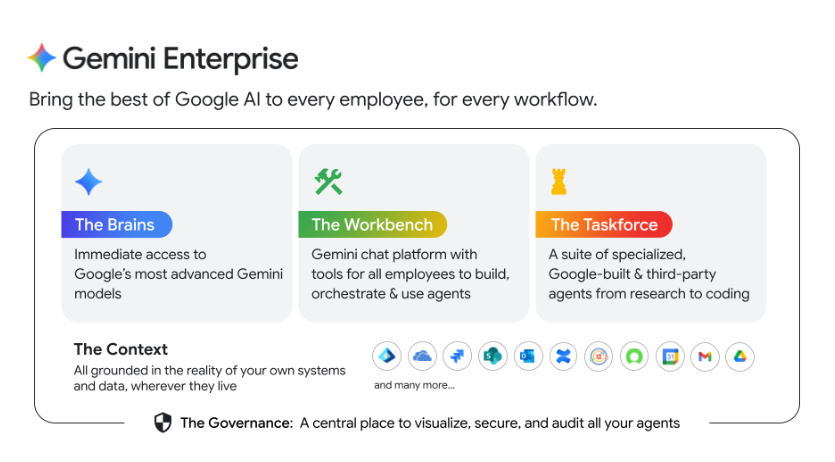
Five Core Pillars of Gemini Enterprise
Gemini Enterprise Helps Enterprises Unlock Four Core Applications:
- Work Smarter: Through the no-code agent builder, anyone can transform professional expertise into AI assistants and automate cross-system tasks.
- Deep Research: Using NotebookLM and deep research agents, hundreds of internal documents, external web pages, and market data can be summarized into presentation-ready, precise insights within seconds—even converted into podcasts.
- Multimodal Creativity: With simple prompts, AI agents can analyze audience preferences and generate high-quality, customized content and high-conversion marketing campaigns in your brand’s unique voice.
- Built-in Code Assistance: Gemini Code Assist helps development teams write code faster, reduce errors, and efficiently refactor complex technical debt. Additionally, through the open Agent2Agent protocol, AI agents can coordinate seamlessly across platforms while maintaining development flexibility and enterprise security under built-in safety guardrails.
Google Workspace vs. Gemini Enterprise Comparison Table
To help decision-makers choose the most suitable tool, the following summarizes the core positioning and functional differences between the two:
|
Google Workspace (with Gemini)
|
Gemini Enterprise
|
|
|---|---|---|
|
Core Positioning
|
Collaboration Foundation: Integrates AI into daily tools like Gmail, Docs, Sheets
|
Agent Portal: Platform for driving end-to-end workflows and autonomous AI agents
|
|
Target Users
|
All enterprises seeking to improve daily office efficiency
|
Enterprises seeking digital transformation and automation of complex business processes
|
|
Key Features
|
AI writing, email summarization, smart reports, video creation
|
Deep research agents, creative generation agents, no-code Agent Designer
|
|
Data Integration
|
Primarily Workspace internal data (Drive, Mail)
|
Cross-System Grounding: Supports integration with CRM, ERP, Jira, Salesforce, etc.
|
|
ROI Performance
|
Saves 105 minutes/week on average; 336% three-year ROI
|
Significantly reduces cross-system task time (e.g., from 15 minutes to seconds)
|
Launch Your Agentic Productivity Revolution Now
If enterprises want to maintain a competitive advantage in the AI era, they can no longer let employees remain trapped in fragmented, isolated single-point tools. By using Google Workspace as a solid and secure foundation for daily collaboration, combined with Gemini Enterprise as a powerful cross-system agent orchestration center, enterprises can completely eliminate hidden costs and upgrade AI from a passive Q&A tool to a “Digital Task Force” capable of autonomously executing end-to-end processes. More importantly, all this disruptive innovation runs securely on the Zero Trust highest-security commitment of “Your Data Is Your Data.” In the future, enterprises that can deeply integrate AI into business processes and create their own “Agentic Office Spaces” will demonstrate unmatched agility and decision-making power in the marketplace.
Ready to open your new era of agentic offices?
Don’t let fragmented tools slow down your enterprise’s growth. Contact our technical experts now to create a customized AI transformation blueprint for your enterprise and experience how Gemini Enterprise can inject powerful automation momentum into your organization.
FAQ
Q: Do I need Google Workspace first to adopt Gemini Enterprise?
A: No. Gemini Enterprise offers extremely high architectural flexibility and supports parallel operation with existing enterprise environments, without requiring large-scale system migration:
- Identity Integration: Enterprises can use Cloud Identity (Google’s identity and access management platform) for authentication and security control. This means that even if you maintain Microsoft 365 for email and collaboration, employees can still securely log in and use Gemini’s agent capabilities.
- Cross-System Grounding: The strength of Gemini Enterprise lies in its ability to directly connect to enterprise business systems, including Microsoft 365 (OneDrive, SharePoint), Salesforce, Jira, and more.
- Hybrid Deployment Advantages: You can define Gemini Enterprise as your enterprise-level agent orchestration layer without changing employees’ existing office habits, thereby connecting information assets scattered across different cloud spaces (such as M365 and Google Cloud).
1 Fragmentation Tax:Refers to the hidden costs enterprises pay due to using too many isolated software applications or systems.
2 The AI Agent Handbook: 10 practical hacks to use AI agents for business, Google Cloud
3 Shadow AI:Refers to the phenomenon where employees privately use artificial intelligence tools (such as ChatGPT, Claude, or various AI image generators) in their work without the permission, authorization, or supervision of the enterprise IT department.
4 Grounding:Connecting the model with real-time, authentic internal enterprise data to ensure that AI responses are accurate and evidence-based, rather than fabricated information (hallucinations) generated out of thin air.