

At last year’s Google Cloud Next ’25, Google invited global enterprises to imagine a new future for AI; this year at Next ’26, the focus shifts to more concrete implementation: How can enterprises deploy AI into production environments and apply it across the entire organization?
Google Cloud CEO Thomas Kurian pointed out in his keynote that the answer lies in a “Unified Stack.” This stack includes chips designed specifically for models, models deeply integrated with enterprise data, and agents and applications driven by these models. Microfusion has observed that AI is evolving from simple chatbots into an era of “Agents” capable of executing complex business tasks. Below is a summary of the key technological highlights from Google Cloud Next ’26.
Google Cloud CEO Thomas Kurian: “Enterprises need a unified stack architecture, including ‘chips designed specifically for models, models built on enterprise data, and Agents and applications built with these models,’ with the entire system secured by the infrastructure.” (This is the same unified stack architecture Google uses for Search, YouTube, Chrome, and Android.)
This article will quickly take you through the highlights of the Google Cloud Next ’26 keynote:
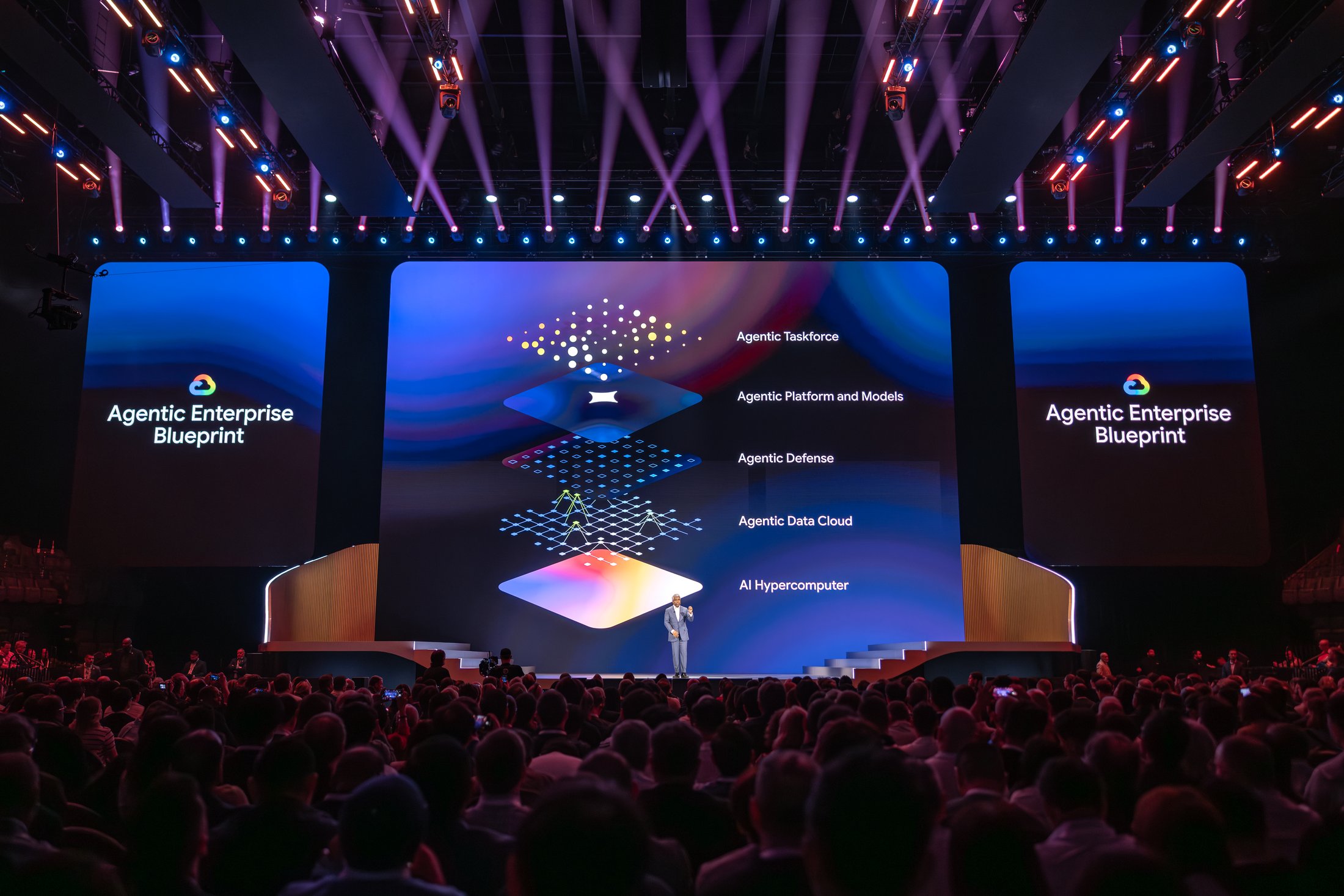
Gemini Enterprise: An End-to-End System for the Age of Agents
Connecting this unified stack is Gemini Enterprise—the “connected organization between enterprise data, people, and goals,” providing a combination of intelligence and automation across multiple levels. Here are the seven key highlights:
1. Gemini Enterprise Agent Platform
Gemini Enterprise is the core for building, scaling, governing, and optimizing agents. As an evolution of Vertex AI, it is built on Google Cloud’s leading infrastructure and deeply integrated with data and security features—the foundation of the “Agentic Enterprise.” Below are the new features and capabilities of the Agent Platform compiled by Microfusion:
- Build: Choose the right environment for the job—from the low-code visual interface of the brand-new Agent Studio, to the code-first logic of the upgraded Agent Development Kit (ADK). Google Cloud simplifies the lifecycle with AI-native code-writing capabilities, helping developers deliver production-grade Agents faster.
- Scale: Clear the path to production with the redesigned Agent Runtime. It supports long-running agents that can maintain state for days, backed by persistent long-term context provided by the Memory Bank.
- Govern: Establish centralized monitoring through Agent Identity, Agent Registry, and Agent Gateway. These features help ensure that every Agent (whether built on the Agent Platform or from the partner ecosystem) has a traceable identity and operates within enterprise-grade guardrails.
- Optimize: Guarantee quality through Agent Simulation, Agent Evaluation, and Agent Observability. These tools provide complete execution traces and real-time visibility into agent reasoning, helping ensure agents consistently achieve their goals.
2. Gemini Enterprise Applications
Gemini Enterprise Applications are the “primary environment where the enterprise actually operates,” Thomas explained. Within this application, many employees (especially non-technical staff) can ask Gemini Enterprise questions, create generative media, interact with pre-built Agents, and even create their own Agents through a conversational interface—Gemini Enterprise also has built-in governance, compliance, and security. Here are the new features in this foundational interface:
- Gemini Enterprise Projects give Agents permanent memory.
- Deep Think solves the most complex business challenges without context pollution.
- Microsoft 365 interoperability allows users to easily export documents created using Canvas into Microsoft Office formats.
To showcase the powerful capabilities of Gemini Enterprise, three-time Olympic gold medalist, entrepreneur, and snowboarding legend Shaun White also took the stage at the event. Together with Jason Davenport, a technical lead at Google Cloud, he demonstrated a model developed through a collaboration between Google Cloud and Google DeepMind. This model tracks Shaun’s movements in space using 2D video, helping him gain a better understanding of his movements and facilitating future physical optimization.
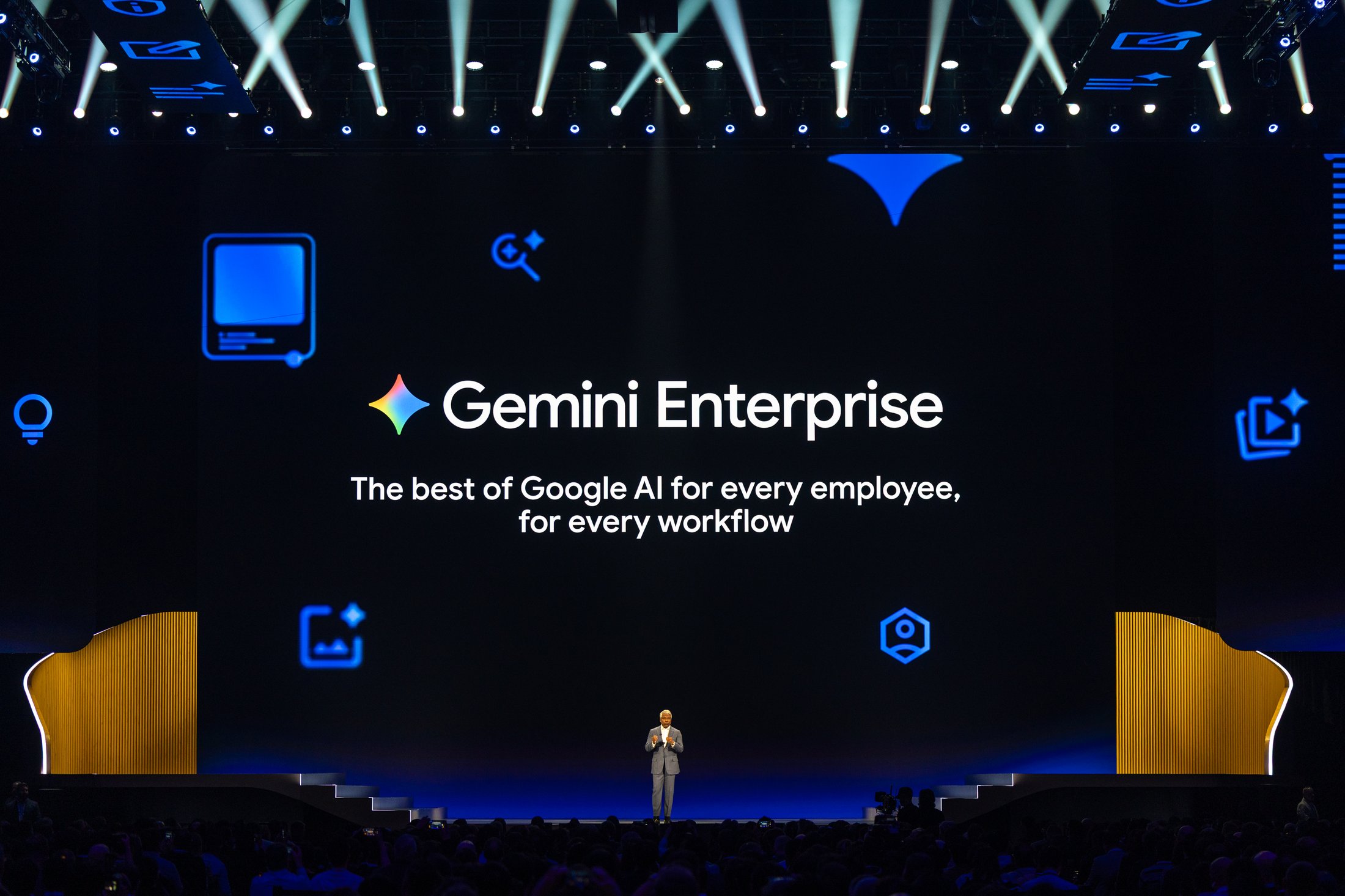
3. AI Hypercomputer
Amin Vahdat, Senior Vice President and Chief Technical Expert of AI and Infrastructure, took the stage to announce upgrades to the AI Hypercomputer, the integrated supercomputing system powering every AI workload on Google Cloud.
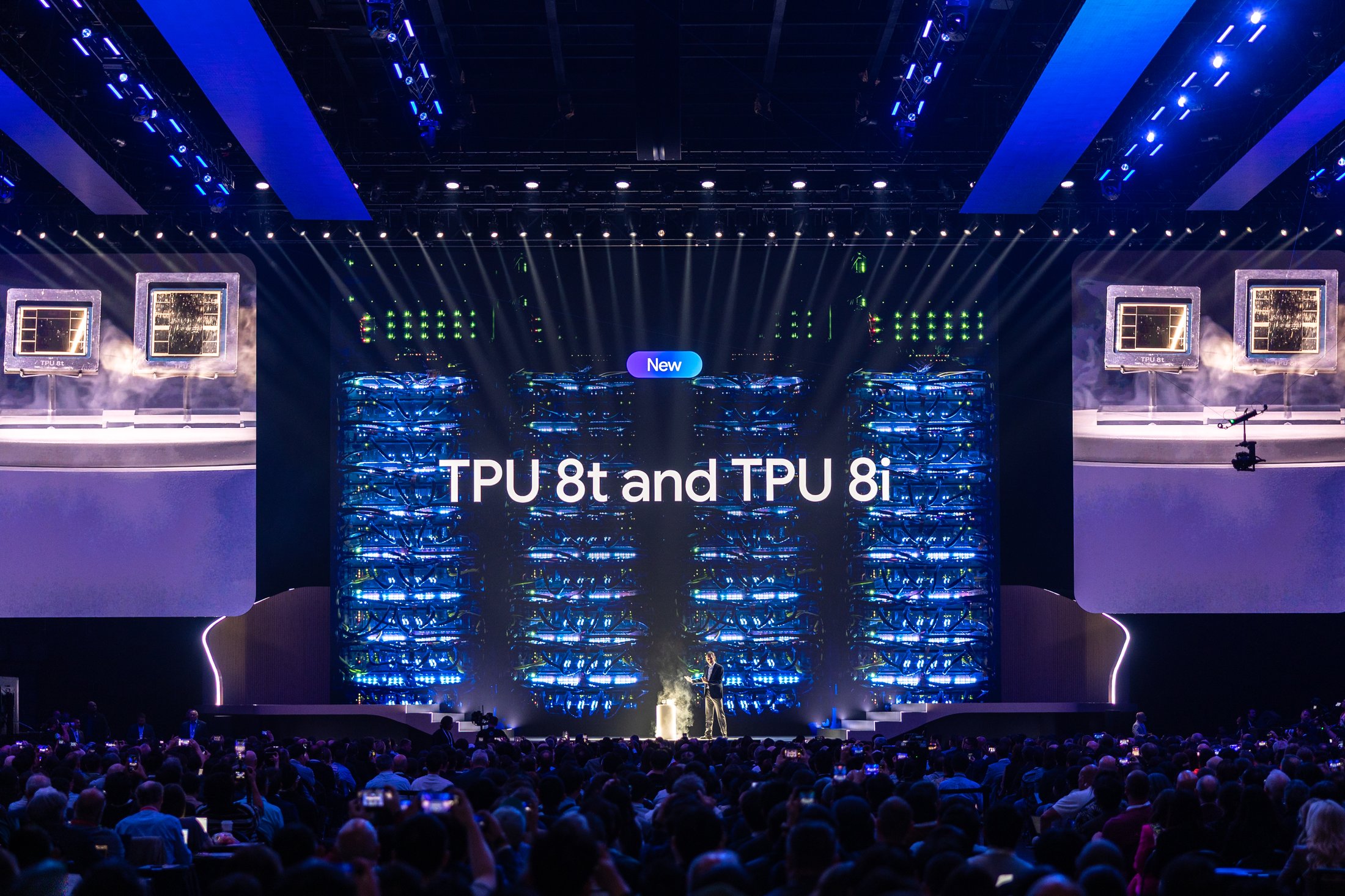
The 8th generation Tensor Processing Unit (TPU) actually consists of two chips:
- TPU 8t: Designed specifically for high-speed AI model training, using new chip-to-chip interconnect (ICI) technology, scalable up to 9,600 TPUs and 2 PB of shared high-bandwidth memory in a single superpod. It has three times the processing power of Ironwood and up to twice the performance per watt.
- TPU 8i: Optimized for inference, using the new Boardfly topology to directly connect 1,152 TPUs in a single pod. Compared to previous versions, it has three times the on-chip SRAM and a dedicated Collectives Acceleration Engine to offload resource-intensive tasks. Combined, TPU 8i offers an 80% improvement in performance per dollar for inference compared to the previous generation.
AI Hypercomputer also supports Arm-based Google Cloud Axion processors (such as the N4A) and will be among the first cloud services to offer the NVIDIA Vera Rubin NVL72 platform. In addition, the new Virgo Network doubles connectivity, and Google Cloud Managed Lustre now supports an industry-leading throughput of 10 TB per second.
4. Agentic Data Cloud
The AI era depends on massive amounts of data. But this data needs to be contextual, because “reasoning without context is just a guess.” To this end, Google Cloud has completely rethought its data platform and given it a new name: Agentic Data Cloud.
- Knowledge Catalog builds a unified, dynamic context graph across the enterprise, anchoring agents to all business data and semantics. Through Smart Storage and the Object Context API, files in Cloud Storage are instantly tagged and enriched with metadata before agents even touch them.
- Data Agent Kit provides a Gemini-powered data science coding experience in IDEs, Notebooks, and agent terminals.
- Lightning Engine for Apache Spark is a real-time serverless engine that is 4.5 times faster than open-source alternatives.
- Cross-Cloud Lakehouse, based on Apache Iceberg, allows enterprises to query data directly in Amazon Web Services or Azure without replication.
5. Agentic Defense
AI makes everything faster, and security operations are no exception. “Human analysts are increasingly unable to keep up with AI-driven attacks,” said Francis deSouza, President of Security Products and COO. “Security must become an autonomous force, responding faster than the threats themselves.” To this end, Google Security Operations introduces three new agents:
- Threat Hunting agent: Helps teams proactively hunt for new attack patterns and stealthy behaviors that bypass traditional defenses.
- Detection Engineering agent: Identifies coverage gaps and creates new detections for threat scenarios.
- Third-Party Context agent: Enriches workflows with contextual data from third-party content.
In addition, Wiz (now part of Google Cloud) has introduced new features, including: vibe-coded applications, the use of inline AI security hooks to mitigate risks associated with AI-generated code, agent-based remediation capabilities, and an AI Bill of Materials (AI-BOM) for automated environment inventory.
6. Workspace Intelligence
For end-user AI applications, Microfusion has also compiled insights shared by Yulie Kwon Kim, Vice President of Product for Google Workspace. Workspace Intelligence is a unified semantic layer that breaks down information and context silos for enterprises.
- Ask Gemini in Google Chat allows users to synthesize information in real-time, present insights, and query projects directly from the chat window.
- Reimagined content creation in Docs, Sheets, and Slides uses Workspace Intelligence to synthesize information and create professional drafts that match brand styles.
- AI Inbox and AI Overviews in Gmail create a personalized, proactive inbox assistant powered by Gemini.
- Google Drive Projects organize team files and emails in real-time, representing a completely new way for Google to transform Drive from a storage tool into an active collaborator.
- Workspace Agents can execute complex, multi-step tasks across Google Workspace applications.
7. Agentic Commerce
For enterprises, AI Agents are reshaping how consumers interact with brands. “In the age of agents, an Agent is not just a tool; it is a strategic extension of the enterprise business,” said Carrie Tharp, Vice President of Go-to-Market Industry Strategy at Google Cloud.
Gemini Enterprise for Customer Experience provides a suite of tools to enhance the entire customer journey:
- Shopping Agent and Ordering Agent: Bring new conversational commerce capabilities directly to the enterprise interface.
- Omnichannel Gateway: Helps agents maintain context across web, mobile, and voice.
- Agent Assist: Provides assistance in complex customer service situations, guiding employees to provide more accurate answers through generative AI grounding.
In particular, the Omnichannel Gateway bridges the gap between physical and digital experiences. “If a customer switches from text chat to a voice call, the agent will seamlessly pick up exactly where they left off,” Carrie concluded. In the age of agents, this is precisely the kind of progress in customer experience that businesses are striving for.
Microfusion’s Insights: Key Strategies for Moving from the Lab to Productivity
The various updates at Google Cloud Next ’26 show that AI has officially entered the stage of “productivity implementation.” However, Microfusion reminds us that for enterprises to move AI from Pilot to Production, in addition to choosing the right tools, the “alignment of organizational structure” is even more critical.
With its deep cloud technology expertise, Microfusion was awarded the 2026 Google Cloud Taiwan Partner of the Year, capable of assisting enterprises with data governance, architecture optimization, and security defense implementation. We do not just provide cloud tools; we are a strategic partner for enterprises throughout their AI transformation journey.
Want to learn more about how to apply these new technologies to your business?
Mirofusion is ready to assist you with an enterprise AI health check and implementation consultation. Contact us today and let AI Agent become a powerful driver of your business growth!
The above content is reprinted from the Google Blog.