


As we enter 2026, retail industry investment in AI has shifted from experimental initiatives to precision-driven profitability. As enterprises face mounting pressure from rising IT and AI budgets, decision-makers are increasingly focused on the tangible conversion of AI investments into measurable returns.
According to Google Cloud’s latest global survey of the retail and consumer goods industry, a remarkable 78% of respondent enterprises report that generative AI has already delivered measurable ROI in specific business areas. Among companies experiencing revenue growth, 31% indicated that their overall annual revenue increased by more than 10%.¹
The common characteristic shared by these industry-leading brands lies in their successful evolution from passive generative AI tools to proactive “AI Agents” capable of independently solving problems—building a comprehensive “Agentic AI” ecosystem.
Why “Agentic AI” Is the Key to Winning in 2026?
To understand the power of AI Agents, we must first recognize the fundamental shift in human-machine interaction patterns:
| In the past | 2026 |
| Instruction-based | Intent-based |
Traditional Digital Work Models (Including Early Generative AI) In this model, computers function as “passive” tools unable to cross single-function boundaries. Even with generative AI, employees still need to serve as “system connectors”:
|
At its core, this paradigm is “results-oriented.” AI is no longer merely a passive tool, but a collaborative partner equipped with reasoning capabilities. When an employee inputs an intent (e.g., “Optimize inventory”), the AI Agent autonomously completes the following key actions:
|
The core advantage of AI Agents lies in building cross-departmental “digital pipelines.” Through A2A (Agent-to-Agent) protocols and the Model Context Protocol (MCP)², agents across different systems can break down information silos and achieve autonomous collaboration. For instance, when a product suddenly goes viral, the agent system can automatically orchestrate forecasting, production, and logistics—entirely without human intervention. In the e-commerce sector, agents can even autonomously complete secure transactions based on predefined conditions. This frictionless, cross-system execution capability enables enterprises to directly convert market responsiveness into a competitive profitability advantage.
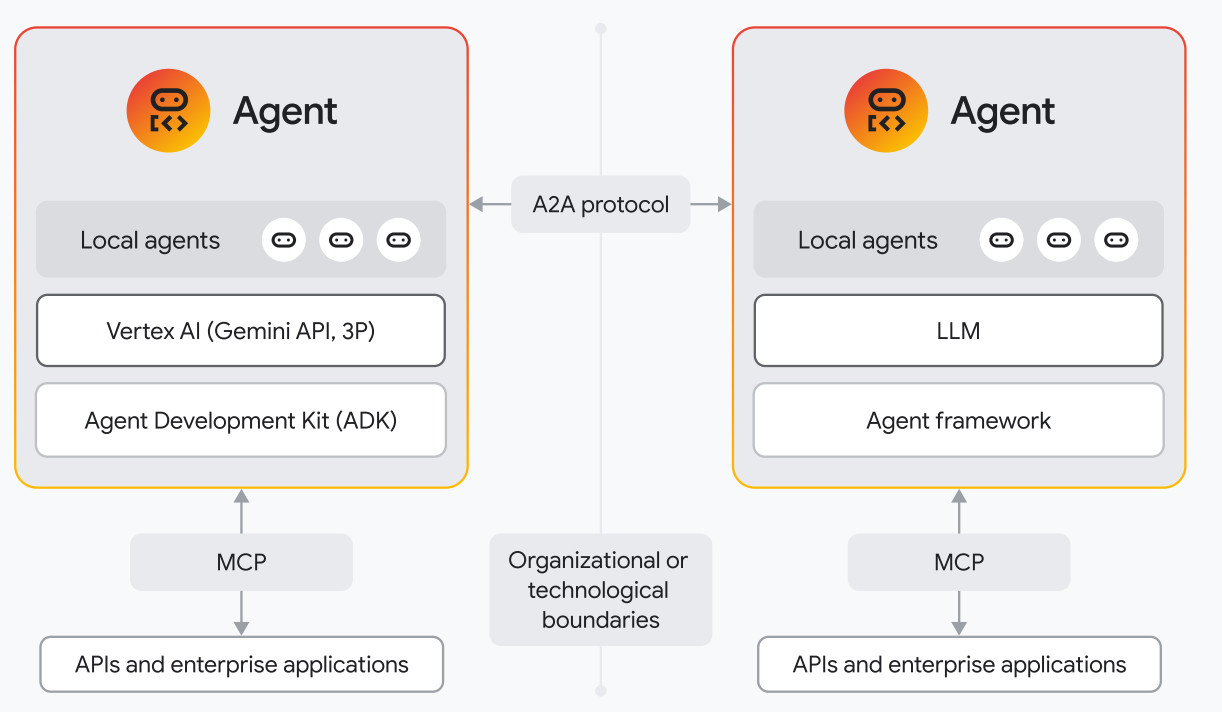
Architecture Diagram for Cross-Organizational Collaboration and Data Integration Among AI Agents
Retail Industry Strategic Layout: Three High-ROI Business Scenarios Driven by AI Agents
Leading enterprises are deploying AI Agents in high-adoption scenarios such as customer service, marketing, and supply chain management—transforming cumbersome processes into significant marginal profits.
1. Transforming Customer Service into a Profit Center: Delivering Proactive, Concierge-Level Service Experiences
By grounding³ AI Agents in enterprise data, customer service can evolve from passive response to automated value-added services.
- Key to Profitability: AI Agents can proactively detect logistics anomalies and instantly execute closed-loop operations—including “automatic compensation, rescheduling, and personalized apologies”—turning potential complaints into opportunities for repeat purchases.
- Proven Results: U.S. home goods giant Wayfair improved processing efficiency by 10 to 20 times through AI collaboration. Currently, the customer service scenario contributes up to 33% of ROI from AI Agent deployments.
2. Maximizing Production Capacity: Building a High-Efficiency Digital Marketing Department
AI Agents empower marketing professionals to transition into team commanders, achieving scalable content production and market analysis through automated collaboration.
- Key to Profitability: By integrating data, content, and creative agents, enterprises can significantly reduce time-to-market at minimal cost.
- Proven Results: U.S. food industry leader Kraft Heinz shortened its creative production workflow from 8 weeks to just 8 hours; Agoda generated 20,000 images within 80 hours, saving 90% in costs. AI Agent applications in marketing deliver an ROI of 32%.
3. Strengthening Operational Resilience: Unlocking Hidden Value in the Supply Chain
Supply chain management is currently one of the highest-adoption scenarios for AI Agents in retail (38%), enabling enterprises to precisely balance operational costs through dynamic scheduling capabilities.
- Key to Profitability: Leveraging AI Agents for dynamic demand forecasting (already adopted by 39% of enterprises for quality control), systems can instantly re-optimize logistics routes when market fluctuations occur, minimizing losses from response latency.
- Proven Results: This agile scheduling capability effectively reduces operational friction, directly converting cost savings into profit.
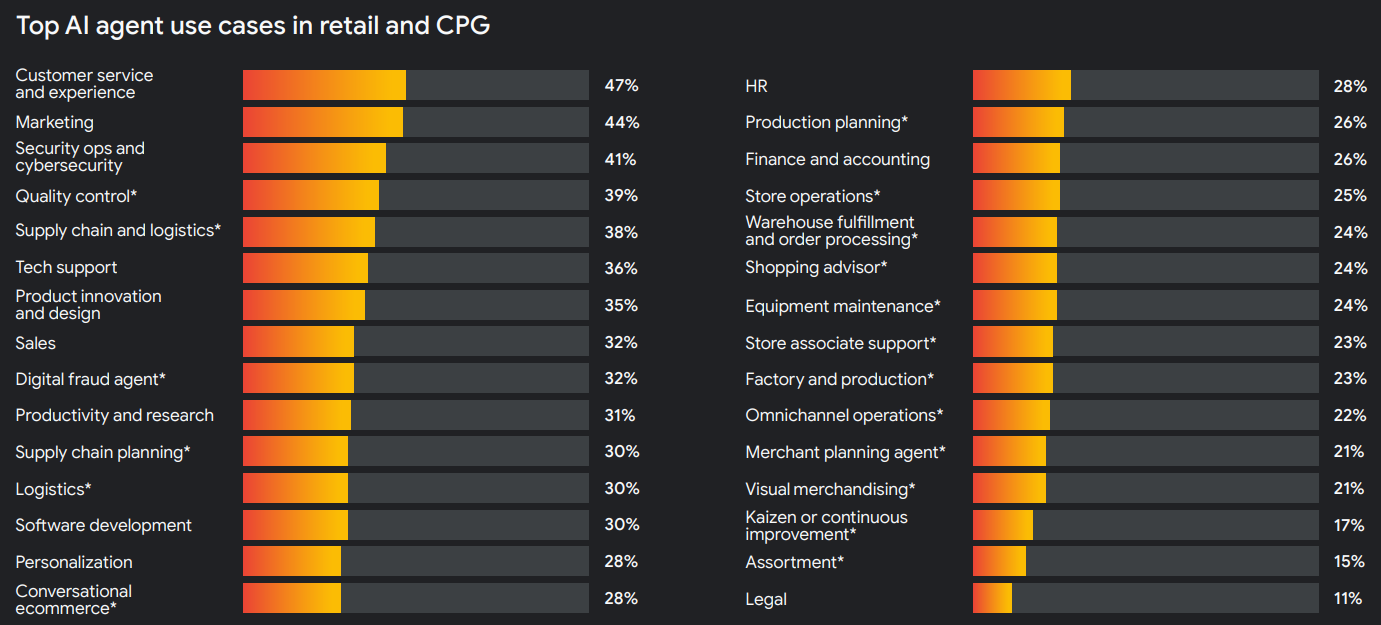
Common AI agent use cases in the retail and consumer goods industry
Microfusion possesses top-tier AI ROI capabilities, backed by profound expertise and rigorous processes. Taking retail leader Carrefour as an example, Microfusion assisted Carrefour in leveraging the Gemini model and AlloyDB vector database to create Taiwan’s first “AI Sommelier” capable of precisely understanding semantics, achieving an actual order conversion rate as high as 70% within just two months of launch. Additionally, Microfusion helped chain restaurant Q Burger implement Vertex AI to build a proprietary public opinion monitoring system that automatically interprets customer reviews from over 370 stores across Taiwan and generates precise responses. From strict PoC (Proof of Concept) validation, architecture integration, to model performance tuning, Microfusion ensures AI projects not only deliver smooth interactions but also substantially drive sales conversion and operational efficiency, truly achieving the commercial implementation of generative AI!
Decision-Maker’s Guide: Four Cornerstones for Ensuring Tangible ROI
Technology deployment is only the beginning; successful ROI transformation depends on organizational management quality and strategic depth:
- Strategic Alignment: C-Level Leadership to Maximize ProfitabilityWhen an organization has a clear executive-level vision, the probability of achieving ROI increases significantly to 80%. This relies not only on cross-departmental collaboration between CEOs and CFOs, but more critically on the strategic restructuring of budgets. Currently, 50% of leading enterprises are reallocating traditional budgets to precisely invest in core areas that build digital competitiveness.
- Digital Resilience: Building Trust Assets for Technology Implementation with Security-First ArchitectureAs many as 36% of senior executives regard data security as the primary barrier to transformation, prioritizing it above cost control. Taking the security platform Torq as an example, AI Agents can autonomously remediate 90% of frontline security threats, accelerating response speed by 10x—enabling enterprises to strengthen core operational resilience while advancing toward ultra-fast automation.
- Skills Revolution: Transitioning from Operators to Strategic Supervisors of AI AgentsFacing the challenge of technology half-life shortening to just 2 years, the core of enterprise transformation lies in talent empowerment. Employees need to evolve from tool operators to supervisors and decision-makers of AI Agents; only through a fundamental shift in management mindset can the long-term value of AI be fully unlocked.
The 2026 Business Landscape Is Being Redefined: Decision-Making and Execution Speed Become Core Competitive Capital
In the 2026 retail market, technological evolution no longer allows enterprises to “wait and see.” Data shows that 89% of retail organizations can transform AI concepts into live projects within 6 months, with 31% of enterprises further shortening time-to-market to 3–6 months. This means AI is no longer a long-term plan, but an operational tool capable of creating value in the short term. For business owners, rather than launching massive initiatives, it is more effective to begin transformation with processes that most directly address operational pain points. Prioritizing AI Agent deployment in time-consuming areas such as customer service, inventory, and marketing can immediately reduce friction costs, allowing core teams to refocus on truly strategic innovation work.
Ready to Launch Your Agentic AI Profitability Blueprint? Contact our professional consultants today to create a customized AI Agent transformation plan for your enterprise.
1 The ROI of AI in retail and CPG, Google Cloud
2A2A (Agent-to-Agent):A collaboration framework designed to standardize communication, authentication, task authorization, and value exchange between different autonomous agents, enabling AI systems to interact and negotiate with each other like humans to accomplish cross-system collaboration; MCP (Model Context Protocol): An open, standardized protocol for context access that enables efficient retrieval of model context and tool invocation.
3Grounding: This refers to linking the model in real time with the company’s actual internal data to ensure that AI responses are accurate and well-founded, rather than false information generated out of thin air.