

In April 2023, Alibaba Group unveiled its self-developed large model, Tongyi Qianwen, with Alibaba Cloud opening early access to select enterprises. The model was officially launched at the Alibaba Cloud Summit on April 11—a milestone that marked not just the debut of a chatbot, but the foundation of Alibaba Cloud’s expansive AI ecosystem.
Within just two years, the Tongyi family has evolved from basic text-based dialogue into a full-spectrum AI ecosystem supporting images, video, code, and multimodal interactions. Today, it stands as one of the world’s largest open-source model families, with over 600 million cumulative downloads and more than 170,000 derivative models—demonstrating its widespread global adoption.
The Tongyi family has moved beyond optimizing individual model performance and is now building a robust AI infrastructure—complete with governance, deployability, and the ability to scale alongside business growth—to help enterprises transition from proof-of-concept to real-world AI adoption. Microfusion will break this down layer by layer: from foundational models at the base, through development platforms in the middle, to enterprise-ready applications at the top—providing a comprehensive view of how businesses can build a complete, end-to-end AI ecosystem.
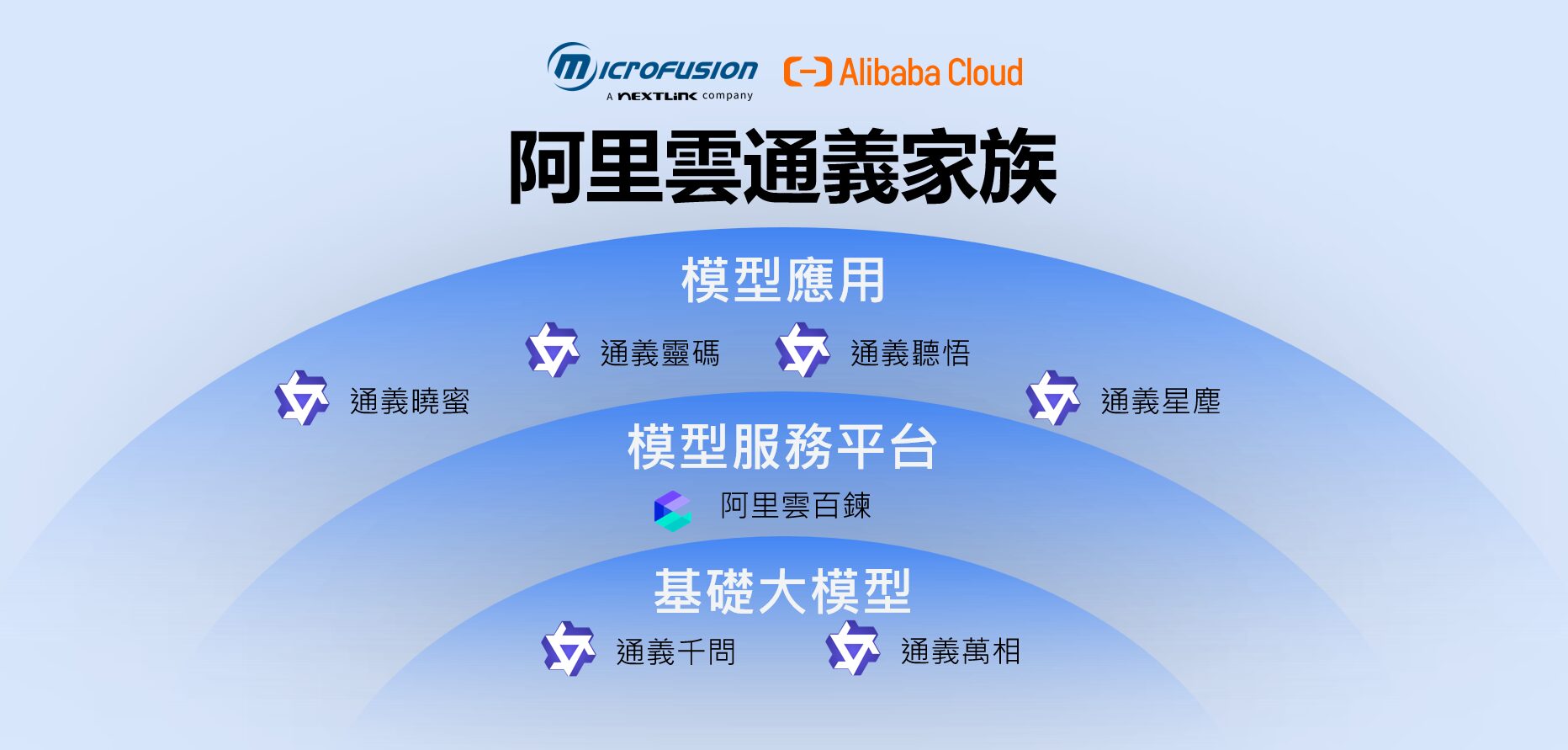
Layer 1: The Foundation – Tongyi Base Large Models
At the heart of Alibaba Cloud’s AI strategy is “Model-as-a-Service (MaaS).” If enterprise digital transformation were akin to constructing a building, the Tongyi family serves as the bedrock and core materials. This foundation is a multimodal model matrix, built upon three key pillars:
The Rational Engine: Qwen – Text & Logic
Qwen is the central “thinking” component of the Tongyi family, specializing in text understanding, logical reasoning, and knowledge synthesis to support high-complexity enterprise decision-making.
Tailored to diverse use cases, the Qwen series offers multiple variants—from deeply analytical models to highly efficient responders—enabling organizations to balance reasoning depth, response speed, and cost. Through continuous iteration, versions such as Qwen-Max and Qwen-Plus now deliver industry-leading performance in Chinese language comprehension and logical inference.
- Qwen-Max
Designed for tasks requiring deep reasoning and high output consistency, Qwen-Max excels at multi-step analysis, strategic judgment, and complex problem decomposition. It is commonly used in enterprise scenarios such as internal decision support, cross-departmental data synthesis, complex workflow evaluation, and high-knowledge applications. - Qwen-Plus
Striking an optimal balance between reasoning capability and cost efficiency, Qwen-Plus is ideal for stable, scalable enterprise applications. Typical use cases include knowledge-based Q&A, process assistance, daily operational support, internal document retrieval, and high-volume task processing. - Qwen-Flash
Built for high performance and low latency, Qwen-Flash is optimized for real-time, high-throughput scenarios. It delivers reliable, reasoning-capable AI responses at lower cost—making it well-suited for customer service chatbots, instant assistants, and interactive applications.
In addition, the Qwen series extends its capabilities to code generation and mathematical reasoning, with specialized models available for domain-specific tasks to further enhance analytical precision and performance.
Creative Perception: Tongyi Wan – The Visual Generation Engine
Tongyi Wan is the creative arm of the Tongyi family, specializing in text-to-image and text-to-video generation. With continuous enhancements—particularly in Wan 2.6—it delivers higher fidelity, greater controllability, and improved usability, enabling enterprises to standardize and scale content production.
With Tongyi Wan, businesses can:
- Rapidly generate brand visuals and media assets, significantly shortening production cycles
- Turn marketing copy directly into short-form videos or dynamic content to accelerate campaign iteration
- Maintain consistent visual styles across campaigns, reducing reliance on external vendors and minimizing revision cycles
Universal Interaction: Tongyi Bailian – Transcending Sensory Boundaries
To deliver more natural cloud service experiences, Alibaba Cloud introduced Tongyi Bailian, a speech-centric model dedicated to speech recognition and synthesis. Within the Tongyi family, Bailian enables AI to understand human speech and respond in voice—creating more intuitive, human-like interactions and significantly enhancing engagement quality between enterprises and their users.
By leveraging Tongyi Bailian, organizations can dramatically reduce manual effort in handling voice content while improving service efficiency and consistency. Voice becomes a systematically managed, scalable interaction interface, well-suited for scenarios such as:
- Intelligent voice assistants and customer service bots
- Automated meeting transcription, interview summarization, and key-point extraction
- Voice-based internal queries and operational support
Together, the Tongyi foundation models turn thinking (Qwen), creation (Wan), and interaction (Bailian) into directly usable enterprise capabilities. Built on a unified architecture and delivered through Model-as-a-Service (MaaS), these capabilities are standardized, modular, and seamlessly integrable—enabling businesses to adopt AI solutions aligned with real-world needs and scale them as operations grow.
Layer 2: The Foundry – Alibaba Cloud Model Studio (Bailian Platform)
Once foundation models enter the enterprise environment, the critical challenge shifts from “how powerful the model is” to “how to use, manage, and sustain it.” If the Tongyi base models provide core AI capabilities, Alibaba Cloud’s Bailian Platform (Model Studio) serves as the engine that transforms those capabilities into deployable, governable, and operationally sustainable AI services.
Bailian is a one-stop platform for large model development and management, bridging the gap between raw model power and real-world enterprise systems. It addresses the fundamental pain point many organizations face: how to effectively integrate AI into existing workflows, infrastructure, and governance frameworks.
Infusing Business Context with RAG
While general-purpose models offer broad knowledge, they often lack awareness of internal business logic. Bailian leverages Retrieval-Augmented Generation (RAG) to securely integrate enterprise documents, knowledge bases, and operational data into the AI’s reasoning process. This ensures responses are grounded in company-specific facts and policies—reducing hallucinations and significantly improving accuracy and relevance.
Building Task-Oriented AI Agents
Enterprises need more than Q&A—they need AI that actively participates in workflows. Bailian offers a modular Agent framework that combines Tongyi’s reasoning, generation, and interaction capabilities with internal systems to create custom AI collaborators. These agents can execute multi-step tasks, trigger actions, and operate within established business processes—evolving AI from a passive assistant to an active workflow participant.
Enterprise-Grade Governance for Safe, Scalable Adoption
As AI becomes mission-critical, robust management, security, and compliance are non-negotiable. Bailian embeds enterprise-grade controls—including fine-grained access policies, audit-ready usage tracking, secure data handling, and flexible deployment options—enabling organizations to adopt AI confidently, in alignment with regulatory and internal standards.
Through the Bailian Platform, the raw potential of the Tongyi family is transformed into managed, scalable, and measurable enterprise AI capabilities. This structured foundation ensures AI doesn’t just exist in isolation—it integrates deeply into business operations, driving tangible value at scale.
Layer 3: Real-World Applications – AI in Action
With a robust foundation of models and a mature platform like Bailian, the true value of AI for enterprises lies in its tangible impact: What concrete benefits can AI deliver? Through the Tongyi family and the Bailian Platform, AI moves beyond proof-of-concept to become an integral part of development workflows, customer service operations, and industry-specific solutions—serving as a practical, everyday assistant that drives measurable business outcomes.
Below, we outline how AI is operationalized through native Tongyi applications and industry-specific use cases, turning advanced capabilities into real, quantifiable value.
Native Tongyi Applications
The Tongyi ecosystem includes ready-to-use AI services that allow enterprises to quickly adopt proven AI solutions without building from scratch.
Tongyi Xiaomi – Intelligent Customer Service Hub
Designed for customer support, Tongyi Xiaomi handles high-volume, repetitive inquiries while optimizing service workflows.
- Supports multi-channel text and voice interactions to boost efficiency
- Reduces agent workload while maintaining consistent response quality
- Transforms customer service data into actionable operational insights
Tongyi Tingwu – Intelligent Audio & Meeting Assistant
Specializing in speech and video understanding, Tongyi Tingwu converts unstructured audio into structured, searchable knowledge.
- Delivers fast, accurate transcription with AI-generated summaries
- Supports meetings, interviews, training sessions, and more
- Cuts manual transcription costs and improves information retention
Tongyi Lingma – AI Coding Copilot for Developers
Integrated into the software development lifecycle, Tongyi Lingma enhances coding productivity and quality.
- Offers intelligent code completion, explanation, and debugging suggestions
- Helps developers understand legacy codebases and system architecture
- Frees engineers from repetitive tasks to focus on high-value innovation
Tongyi Xingchen – Character-Driven Conversational AI
Tongyi Xingchen enables AI personas with distinct personalities and interaction styles for immersive experiences.
- Creates unique character profiles and dialogue tones
- Supports long-context, multi-character conversations
- Ideal for gaming, entertainment, and interactive storytelling scenarios
Industry-Specific Use Cases
- Customer Service & Cross-Border Operations
Leveraging Qwen’s multilingual comprehension and Bailian’s speech understanding, enterprises can deliver consistent, high-quality customer support in high-volume, multilingual environments.
。Core needs: High inquiry volume, multilingual communication, service reliability
。Implementation focus: Semantic understanding, voice interaction, automated responses
。Business value: Reduces staffing pressure and enables 24/7 cross-border support
- R&D and Engineering Teams
Powered by Qwen’s code reasoning and logical analysis, AI assists developers in navigating complex codebases and automating repetitive tasks.
。Core needs: Development efficiency, code comprehension, debugging and maintenance
。Implementation focus: Code understanding, development assistance, task decomposition
。Business value: Frees engineers to focus on high-value innovation while improving code quality and velocity
- Web3 & Financial Risk Control
Using Qwen’s advanced reasoning and pattern recognition, organizations can detect anomalies and assess risks across vast transaction and behavioral datasets.
。Core needs: Risk management, anomaly detection, regulatory compliance
。Implementation focus: Behavioral analysis, relational reasoning, risk scoring
。Business value: Strengthens anti-money laundering (AML) and compliance capabilities without sacrificing operational efficiency
- Gaming & Interactive Content
Combining Xingchen’s character-driven dialogue with Wan’s visual generation, studios can create dynamic, evolving player experiences.
。Core needs: Deep engagement, rapid content iteration, player retention
。Implementation focus: Character interaction, real-time content generation, adaptive storytelling
。Business value: Enhances immersion and extends the lifecycle of game content
The Tongyi family demonstrates that Alibaba Cloud’s strategy goes far beyond offering standalone models. Instead, it delivers an end-to-end AI architecture—integrating foundation models, the Bailian development platform, and real-world applications—all centered on actual enterprise needs. This layered approach enables AI to be systematically embedded into existing systems and scaled across critical business functions, transforming it from experimental concept into a managed, deployable, and growth-ready enterprise capability.
Since every organization has unique requirements and technical contexts, successful AI adoption depends on aligning technology with business architecture. As an Alibaba Cloud Elite Partner, Microfusion helps enterprises evaluate the right Tongyi capabilities for their use cases and design scalable, secure, and cost-effective implementation strategies—ensuring AI is integrated responsibly and delivers measurable ROI.
Contact Microfusion today for a tailored AI adoption assessment and use case consultation.