


In February 2026, the generative AI field reached a significant turning point: OpenClaw (formerly known as Moltbot / Clawdbot), affectionately nicknamed “AI Lobster” by the developer community, once again became a global spotlight as its founder, Peter Steinberger, announced his move to OpenAI. This development not only signifies strategic recognition of Agentic AI technology by a leading industry giant, but also marks OpenClaw’s transformation into an independent open-source foundation structure, backed by ongoing technical support and sponsorship from OpenAI.
This industry shift sends a clear message: the role of AI is rapidly evolving from a conversational partner to an “executor.” While we have traditionally interacted with AI through chat to obtain advice, OpenClaw’s action-oriented capabilities enable it to directly integrate into digital workflows—whether managing emails, handling complex documents, or executing code across systems—it can autonomously and automatically achieve its objectives.
However, as AI evolves from merely offering suggestions to actively performing tasks, the challenges enterprises face have shifted from model selection to ensuring architectural stability and security. This article will guide you through an in-depth exploration of OpenClaw’s core capabilities and analyze how to build a stable, scalable AI Agent execution environment on Alibaba Cloud.
OpenClaw’s Autonomous Agent Architecture and Core Capabilities
In simple terms, OpenClaw is an autonomous agent framework powered by large language models (LLMs), designed to enable AI to invoke tools and execute real-world tasks—going beyond mere content generation. For instance, while using Gemini or ChatGPT typically involves conversational exchanges to obtain desired answers, OpenClaw functions as a personal assistant with operational permissions to interact with your computer and data.
In practical applications, OpenClaw can integrate browser automation, file system access, and external APIs to execute cross-system workflow operations. Examples include automatically scraping and organizing data from specific websites, generating periodic business reports, or assisting with multi-platform messaging and internal process tasks.
From a technical architecture perspective, OpenClaw comprises six core capabilities:
- Cross-Platform and Model Compatibility: Supports macOS, Windows, and Linux systems. It seamlessly switches between OpenAI models, Anthropic’s human-aligned models, or local open-source models. More importantly, it is designed with privacy-first principles, ensuring data always remains under user control.
- Multi-Channel Communication Integration: No need to open specific web interfaces—users can interact directly via WhatsApp, Slack, Discord, Telegram, or iMessage. OpenClaw can also be added to group chats, enabling AI to function as a collaborative team member.
- Dedicated Persistent Memory: Through a specialized long-term memory mechanism, OpenClaw closely tracks user behavior patterns, ultimately evolving into an intelligent assistant tailored to individual preferences and needs.
- Powerful Browser Control: Browses webpages, fills out forms, and extracts key information from any website—just like a human user—enabling fully automated information gathering.
- Full System Access Permissions: Capable of reading/writing files, executing Shell commands, or running scripts. Users can grant “full access permissions” based on their needs or restrict operations to a “sandbox environment,” balancing convenience with security.
- Infinitely Extensible Skill Plugins: Expand functionality using community-developed skills or create custom proprietary skills. Remarkably, OpenClaw even possesses self-evolution capabilities, enabling it to write its own code to solve novel problems.
Founder Peter Steinberger once shared a striking anecdote in an interview. After a user installed OpenClaw, they casually issued a command: “Please scan my entire computer and help me organize a review of my life and work over the past year.”
Surprisingly, OpenClaw did not merely browse surface-level folders. Like a professional investigator, it autonomously determined where to dig for information. It even proactively uncovered personal audio recordings the user had long forgotten—weekly recordings made a year earlier. Ultimately, OpenClaw synthesized documents, projects, and these audio files to produce a highly contextualized annual narrative.
Therefore, OpenClaw is closer to an AI execution engine capable of orchestrating workflows, rather than a simple conversational chatbot.
Cloud Deployment Requirements for AI Agent Architecture
AI Agents are long-running, service-oriented architectures characterized by continuous task execution, cross-system integration, and state maintenance. Compared to one-time conversational tools, this type of architecture requires stable computing resources, always-online capabilities, and reliable external network connectivity to ensure uninterrupted workflow execution. Although OpenClaw can be deployed on local devices for testing or development purposes, production environments running locally may be affected by factors such as device shutdowns, dynamic IP addresses, bandwidth limitations, or system resource allocation—potentially interrupting task execution or reducing stability.
Therefore, deploying AI Agents on cloud infrastructure with high availability and elastic scalability provides a more stable operating environment and long-term service capability, enabling autonomous agent architectures to truly deliver their value in continuous execution and process automation.
Advantages of Alibaba Cloud’s Integrated Deployment Architecture
To address the requirements of AI Agent architectures for long-running operations and cross-system integration, Alibaba Cloud offers standardized and stable cloud deployment models. This ensures that OpenClaw deployment is not only technically feasible but also operationally sustainable.
1. Standardized Operating Environment
Through pre-configured OpenClaw application images, enterprises can establish consistent operating environments in the cloud, avoiding deployment instability caused by differences in local devices or package version conflicts.
Microfusion Recommendation: Build a stable Agent architecture without relying on specific local devices (e.g., personal computers running continuously).
2. Stable, Always-Online Infrastructure
The core value of AI Agents lies in continuous task execution and uninterrupted workflows. Cloud servers provide stable public network connectivity and long-term computing capabilities, ensuring predictable availability for agent tasks.
Microfusion Recommendation: Compared to local environments that may experience interruptions due to shutdowns or network fluctuations, the cloud is better suited as a production-grade operational architecture.
3. Scalable Deployment Models Based on Business Needs
At the deployment level, enterprises can select the appropriate setup method based on application maturity and resource requirements:
- SAS (Serverless Application Service): Ideal for prototype validation or small-to-medium-scale applications—fast deployment with lower entry barriers.
- ECS (Elastic Compute Service): Suitable for high-concurrency or production-grade scenarios, offering higher-spec computing resources and flexible configuration capabilities.
This layered deployment approach enables enterprises to choose corresponding cloud architectures at different development stages, without forcing a one-size-fits-all solution across all scenarios.
4. Native Model Integration Capabilities
Regardless of whether SAS or ECS deployment models are adopted, enterprises can integrate Qwen (Tongyi Qianwen) models via Model Studio (BaiLian), centralizing API and permission management to reduce model integration complexity.
Microfusion Recommendation: Centralizing models and operating environments helps improve operational efficiency and architectural controllability.
Setting Up an OpenClaw Cloud Runtime Environment on Alibaba Cloud
In early application scenarios for OpenClaw, many developers opted for local deployment on personal devices (such as Mac mini). This approach is well-suited for prototype validation and functional testing; however, for long-running operations and production use cases, it may encounter stability challenges.
By deploying OpenClaw on Alibaba Cloud’s cloud environment, enterprises can run OpenClaw on more stable and scalable infrastructure, making the autonomous agent architecture better suited for enterprise-grade environments.
Comparison of Local Deployment vs. Cloud Deployment Models
|
Comparison Aspect
|
Local Deployment (e.g., Mac mini)
|
Cloud Deployment (e.g., Alibaba Cloud SAS)
|
|---|---|---|
|
Operational Stability
|
Affected by device status and network connectivity; may be interrupted by shutdown or sleep mode
|
Features 24/7 continuous online capability
|
|
Environment Operations & Maintenance
|
Requires manual installation of dependencies and resolution of version conflicts
|
Provides standardized images, reducing environment discrepancies
|
|
Resource Flexibility
|
Limited by physical hardware specifications
|
Can select different instance specifications based on requirements
|
|
Applicable Scenarios
|
Prototype development and small-scale testing
|
Long-term operation and production environments
|
Enterprises can follow the process below to deploy OpenClaw on Alibaba Cloud’s Simple Application Server (SAS). The overall workflow centers on standardized environments and model integration, eliminating the need to configure complex dependencies from scratch.
Step 1: Create a Cloud Instance
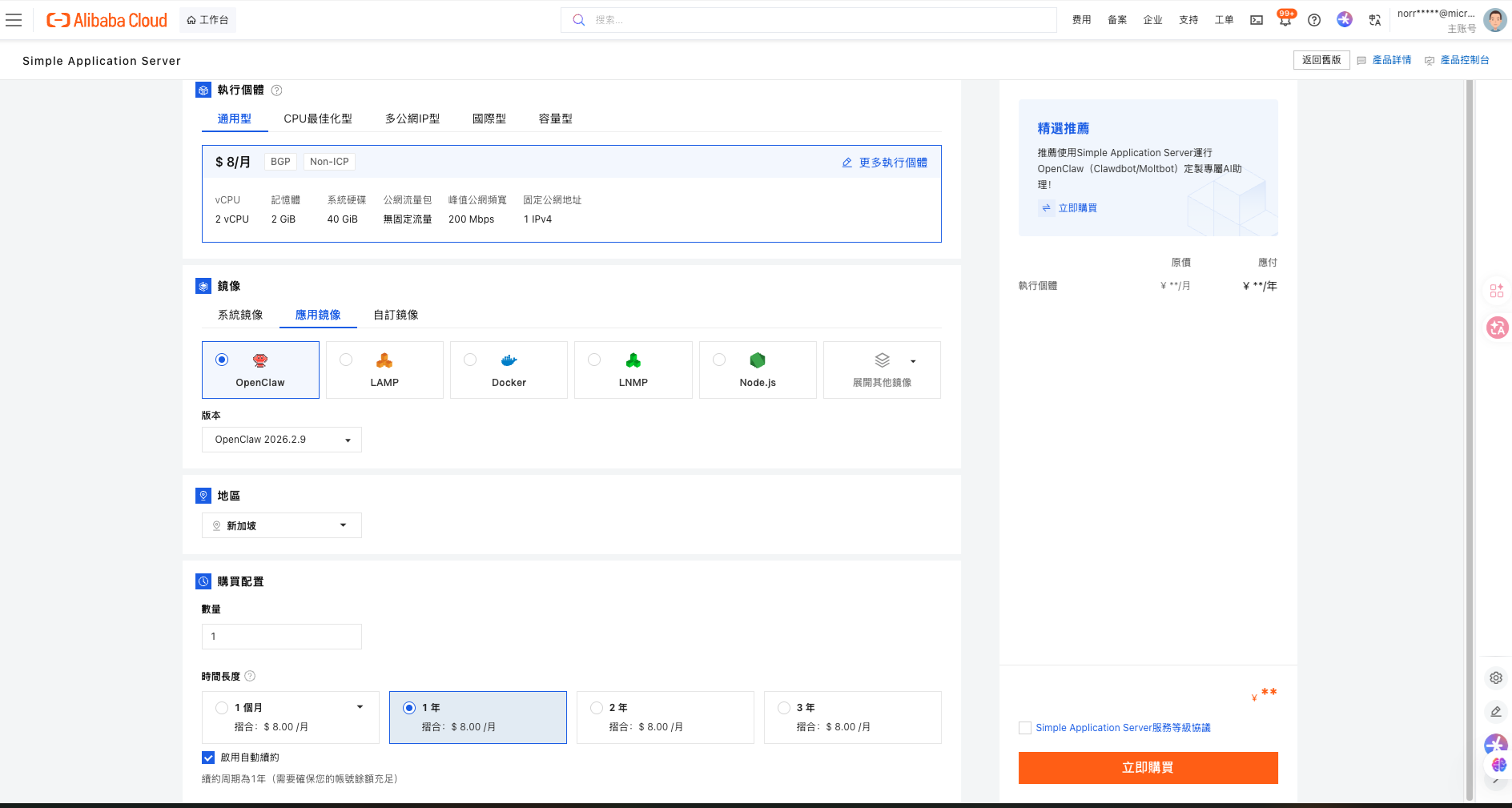
When creating a Simple Application Server (SAS) instance in the Alibaba Cloud console, ensure the minimum resource configuration is at least 2 vCPUs and 2 GB of RAM to guarantee basic system performance. After instance creation, select the pre-configured OpenClaw application image from the marketplace. Once the instance is provisioned, you will have a remotely accessible runtime environment.
Step 2: Configure Model Inference Credentials
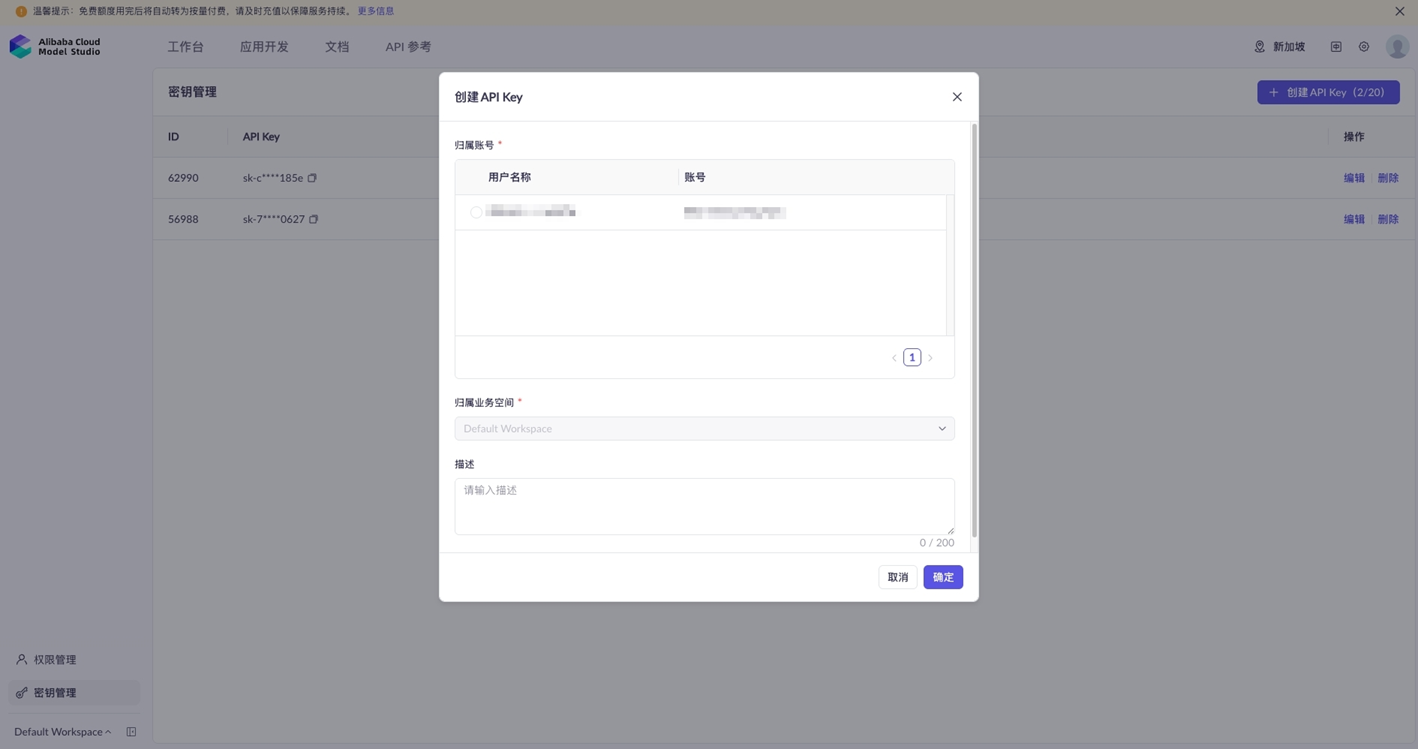
Navigate to Model Studio (BaiLian) to create an API Key, then configure this key within the OpenClaw environment to enable integration with the Qwen (Tongyi Qianwen) model as the inference core.
Step 3: Verify Network and Access Permissions
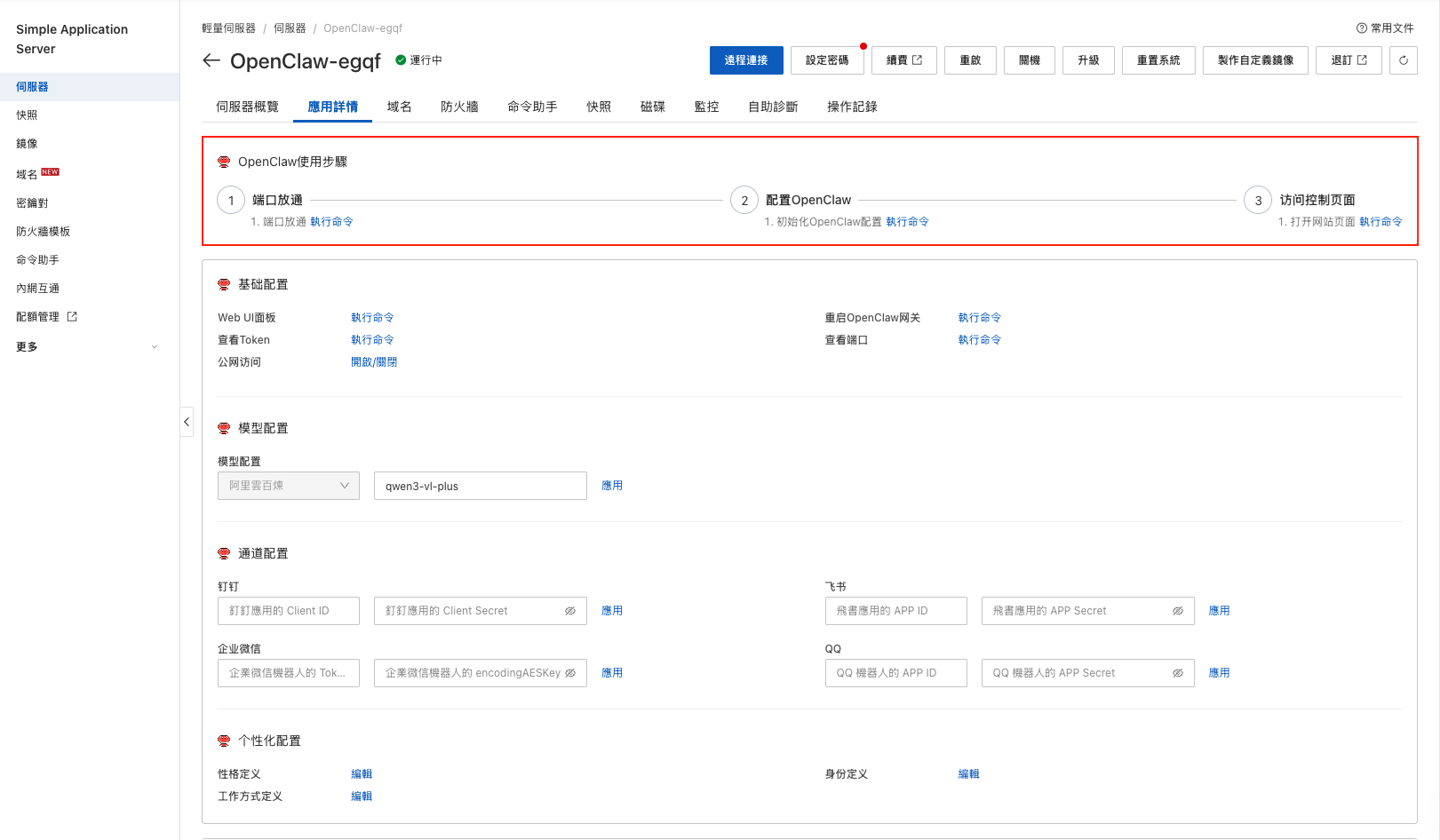
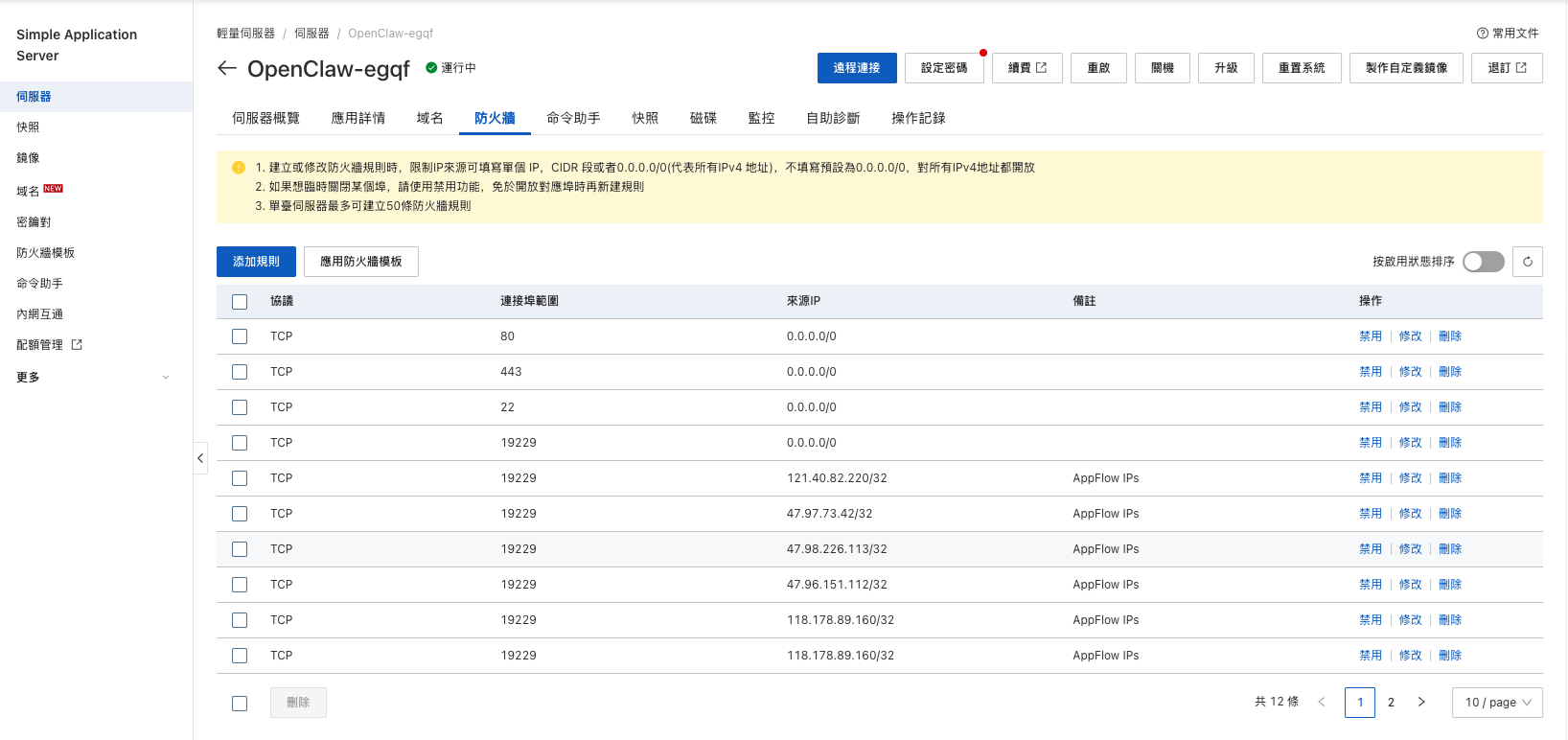
Configure security group rules and public network access scope based on application requirements, ensuring the Agent can properly access external websites or APIs while avoiding unnecessary open ports.
Step 4: Launch and Validate
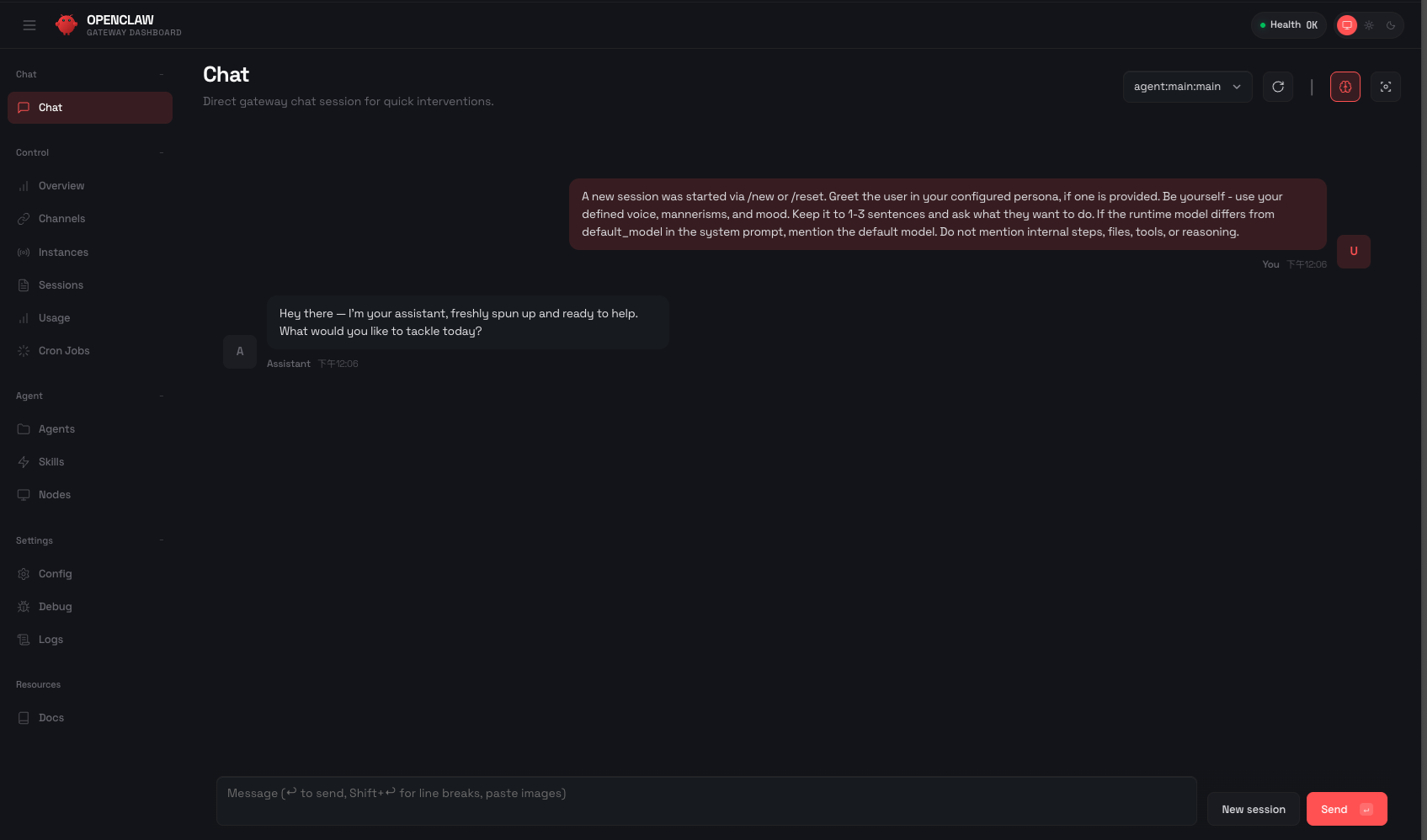
After completing configuration, start the OpenClaw service and perform basic functional testing—such as executing simple task workflows or validating tool invocation—to confirm stable overall operation.
By following this process, enterprises can establish a cloud-based AI Agent environment with continuous runtime capabilities, laying the foundation for subsequent workflow design and automation scenario expansion.
Security and Governance Considerations for OpenClaw Deployment
One of the most critical aspects of OpenClaw is security. Since OpenClaw is an autonomous agent architecture with high privileges and external operational capabilities, security protection mechanisms should be planned concurrently during cloud deployment to ensure system controllability and manageable risk.
1. Infrastructure-Level Protection Measures
- Network Access Control
It is not recommended to expose ports directly to the public internet. Instead, restrict source IPs through security groups or use private channels such as VPN for access control, reducing the risk of unauthorized connections. - Privilege-Separated Execution
It is recommended to run the OpenClaw service using a restricted-privilege account, avoiding direct execution with highest-level administrative privileges (root), to minimize the potential system impact in case of intrusion. - Regular Snapshot Backups
Establish a regular backup mechanism through cloud disk snapshots. If skill contamination or abnormal behavior is detected, the system can be quickly restored to a secure state.
2. Skill and Behavior-Level Control Mechanisms
- Skill Source Review
Install only skills from trusted and reviewed sources, avoiding the use of unverified or unknown-source expansion plugins. - Host Execution Monitoring
Monitor the host dashboard—including CPU, memory, network bandwidth, and system disk read/write activity—to ensure the host maintains normal operation. - Manual Confirmation for Critical Operations
For high-risk operations involving data deletion or external information transmission, it is recommended to incorporate a manual confirmation process to avoid potential risks associated with fully automated decision-making.
By implementing the above protection measures, enterprises can maintain OpenClaw’s autonomous agent capabilities while establishing a risk management framework aligned with operational requirements, ensuring AI Agents remain controllable and stable in cloud environments.
Empowering AI Agents as a Sustainable Enterprise Capability
OpenClaw represents a pivotal shift in AI—from “generating content” to “executing tasks.” However, the key determinant of its effectiveness lies not solely in model capabilities, but in overall architecture design, deployment planning, and security governance strategies.
As an Alibaba Cloud Elite Partner, Microfusion has long specialized in cloud architecture and enterprise-grade deployment practices, with deep expertise in resource planning, model integration, and permission control design for Alibaba Cloud SAS and ECS.
Microfusion not only assists enterprises in setting up OpenClaw environments but also evaluates application scenarios and risk management from an architectural perspective, ensuring AI Agents can operate stably and genuinely support business processes.
If you are evaluating the application of AI within your internal enterprise environment, please contact the Microfusion team. We will assist you—from scenario analysis and resource selection to security governance—in building a sustainable, long-term AI execution architecture.